


(This article was originally published in sportskeeda.com on May 24, 2012)
2012 Monaco Grand Prix: Yet another exhilarating weekend in the offing!
2012 Monaco Grand Prix: Yet another exhilarating weekend in the offing!
The first five races of the 2012 Formula 1 season have been exciting to say the least. We have had different winners in each of those races which is a feat that has happened only once before (1983). With no clear favorite emerging for neither the driver’s championship nor the constructor’s championship, this season is poised to be one of the most fascinating ones in the history of F1.
With that being said, the sixth grand prix of the season takes place in the principality of Monaco, this weekend. One of the crown jewels of F1, Monaco has been one of the most anticipated races on the F1 calendar. This year promises to be no different. The twists and turns of this street circuit make life difficult for the drivers but a treat for us to watch them handle their mean machines in the narrow lanes of Monaco.
The narrowness of the street circuit is a striking feature unique to Monaco alone. This has been a bane when it comes to overtaking. Being a street circuit, it is also slippery, making it even more difficult for the drivers to have a leash on their cars. They have to be at their best during all of the 78 laps in this 3.34 km long circuit. But can a driver do well at Monaco just by being at his best on circuit? Certainly not!
Monaco is all about getting the strategy right. Teams and drivers should make the right choice of tyres and pit at the best possible time for success in this one-of-a-kind circuit.
Like last year’s race here, the soft and super-soft Pirelli P-Zero tyres will be used during the race on Sunday. While you may be familiar with the yellow marked soft tyres which have been used in all the races of this season so far, the super-soft tyres are being used for the first time here at Monaco. Given the slippery nature of the track, the tyre degradation may not be that high like the other circuits and hence Pirelli have gone with the super-softs. The super-softs may last around 15 – 25 laps while the soft tyres last about 25 – 35 laps at Monaco. This leaves the drivers in a dilemma whether to go for two stops or three stops in the 78 lap race. Super-softs are the ones which will be used in Q3 and hence at the start of the race by the top 10. After the first stint with the super-softs, drivers will have to choose whether they should use the soft compound or use another set of super-softs. Renault made a bad choice at Catalunya by going for the soft compound after the first round of pit-stops, while all others used the hard compound.
In a dry race, the drivers should use both sets of tyres and hence the choice of tyres for the second and third stint becomes crucial for most of the teams. Last year, the super-softs were used in the second stint by most drivers while the winner Sebastian Vettel went for the soft compound tyres. Using the soft compound earlier in the race also helps in cutting down the number of pit-stops.
Why is it important for the drivers to keep the number of pit-stops down to 2 or may be 3? It is because drivers spend atleast 25 seconds per pit stop at Monaco, according to the data obtained from last year’s Monaco GP. Considering the fact that a lap on the circuit can be covered within 1 minutes and 15 seconds, drivers and teams will be keen to limit the number of pit-stops. This plays into the hands of the drivers who maintain their tyres well in the course of a race, like Perez and Kobayashi.
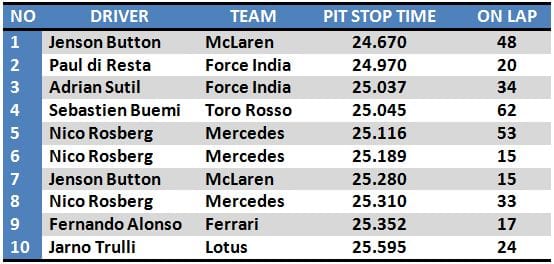
It takes approximately 25 seconds for the driver to complete a pit stop at Monaco. Stats from last year's race allude to this fact.
Last year’s winner Sebastian Vettel made the soft tyres last nearly 50 laps and pitted just twice. Though one might argue that he was helped by the red flag conditions towards the end of the race, other drivers like Kamui Kobayashi and Adrian Sutil also made their soft tyres last for more than 45 laps. In fact, Kobayashi and Sutil used the super-soft tyres in which they started for about 34 laps which clearly underlines the fact that the tyres can be stretched up to their maximum limit before they fall off the cliff.
Getting the under-cut is what all teams look out for in all other races. Williams’ Pastor Maldonaldo used the under-cut to perfection to get his first victory in Formula 1, a couple of weeks ago at the Spanish Grand Prix. However, in Monaco, it is not easy for a driver to pit early and then overtake cars to rise above the field. While it is important for the drivers to decide how many times to pit during the race, they should also pick the right moment to pit. Crashes, safety cars and red flags are a given at Monaco and the drivers who capitalize on these conditions benefit more than those who don’t. Vettel did just that and got the victory last year.
All the strategies discussed above are only for dry conditions. What if it rains on Sunday? Rain makes it really tricky for the drivers. The wet and the intermediate tyres come into play and the race gets even more exciting.
The strategists on the pit wall have to think on their feet and the drivers have to make the correct calls to get their act right at Monaco. With no breakaway leader emerging in the standings for the driver’s and constructor’s championship, victory at Monaco will do a world of good for the winner.
And there is an interesting sub-plot too. Are we going to get a sixth different winner this season? Will it be Renault’s day out in the French principality? Monaco never fails to deliver and this year will be no different. Get ready for yet another exciting Grand Prix in this unpredictable season.
No comments:
Post a Comment